
4G Proxy Explained: Validation, Rotation, and Setup Rules
The Ultimate Guide to 4G Proxy Networking
For data engineers and automation teams, a 4G proxy is often the last line of defense against aggressive blocking. When datacenter IPs are flagged instantly and standard residential IPs struggle with specific geofences, mobile carrier routing offers a higher tier of trust.
However, the mobile proxy market is fragmented. It ranges from professional enterprise networks to instability-prone "SIM farms" running on consumer hardware. This guide provides a technical framework to evaluate, configure, and troubleshoot 4G proxies effectively.
Explore LycheeIP’s Residential Proxy Network
What is a 4G proxy (and why does it work)?
A 4G proxy routes traffic through a device (modem, dongle, or smartphone) connected to a mobile cellular network (LTE/4G). When you use these proxies, your target server sees an IP address assigned by a mobile carrier (e.g., Verizon, AT&T, T-Mobile) rather than a fixed ISP line.
The Mechanism: CGNAT
The primary reason 4G proxies are so effective for scraping and account management is Carrier-Grade NAT (CGNAT).
Mobile carriers typically do not assign a unique public IP to every smartphone. Instead, thousands of real human users share a single public IP address at any given moment. Target websites are hesitant to block these IPs aggressively because doing so would block thousands of legitimate users (collateral damage).
Core Capabilities
- High Trust Score: Indistinguishable from real mobile user traffic.
- Dynamic Rotation: IPs can often be refreshed instantly by toggling the mobile connection (airplane mode toggles).
- Granular Geo-Targeting: Physical devices can be located in specific cities or regions.
4G Proxy vs. Residential Proxy: Which one do you need?
While both offer high anonymity, they serve different operational roles.
| Feature | 4G Proxy | Residential Proxy (e.g., LycheeIP) |
| Source | Mobile Cellular Network | Home ISP (Wi-Fi/Cable) |
| Trust Level | Highest (Hardest to block) | High |
| Speed/Latency | Variable (often slower due to cellular network) | Generally faster and more stable |
| Cost | High ($40–$100+ per port/month) | Lower ($/GB model) |
| Best For | Account creation, app scraping, strict social media platforms | High-volume scraping, market research, ad verification |
Decision Rule: Use a 4G proxy for "scalpel" work, highly sensitive, low-volume tasks like account management or bypassing strict bot detection on mobile-first apps. Use residential proxies for "hammer" work, broad data collection where volume and speed matter more than having a cellular fingerprint.
Explore LycheeIP’s Residential Proxy Network
How to evaluate a 4G proxy provider in 10 minutes (SOP)
Do not commit to a monthly contract without a smoke test. Use this Standard Operating Procedure (SOP) to validate a provider's claims using a small trial or day pass.
- Connectivity Check:
- Configure the proxy in a browser or curl.
- Verify the IP owner matches a known mobile carrier (not a datacenter ASN) using an IP lookup tool.
- Latency Baseline:
- Run 10 requests to a target close to the proxy location.
- Pass Standard: Average latency under 800ms.
- Fail Standard: Frequent timeouts or latency >2s.
- Rotation Control:
- Trigger a rotation (via API or dashboard).
- Immediately check the IP again. It should change within 10–20 seconds.
- Warning: If the IP doesn't change or the connection drops for >60 seconds, the hardware is underpowered or overloaded.
- Passive Fingerprinting:
- Visit a detection site (like browserleaks.com).
- Ensure WebRTC is not leaking your real machine's local IP.
- Ensure DNS requests are being handled by the proxy, not your local ISP.
Which 4G proxy rotation mode fits your workflow?
Misconfigured rotation is the #1 cause of broken automation. You must match the rotation logic to the job.
1. Sticky Sessions (Static/Persistence)
- Behavior: The IP remains the same for a set period or until manually rotated.
- Use Case: Logging into accounts, completing a checkout flow, or navigating a multi-step form.
- Why: Changing IPs mid-session often triggers security challenges (logging out the user).
2. Timer-Based Rotation
- Behavior: The IP changes automatically every X minutes (e.g., 5, 10, 30 mins).
- Use Case: General browsing or "warming up" profiles.
- Risk: If the rotation happens in the middle of a request, the connection will drop. Your code must handle retries gracefully.
3. Per-Request (High Rotation)
- Behavior: Every new connection request gets a fresh IP.
- Use Case: Scraping public data (pricing, product pages) at scale.
Note: True 4G modems take time to "reset" IPs (5–10 seconds). For high-speed per-request rotation, a large pool of dynamic residential proxies is often superior to a single 4G dongle.
Explore LycheeIP’s Residential Proxy Network
Should you pay a vendor or build your own 4G proxy farm using USB dongles and SIM cards?
Build (DIY) is better if:
- Volume: You need 50+ concurrent threads 24/7 and vendor costs are prohibitive.
- Control: You need total control over the exact SIM card, carrier plan, and reset timing.
- Hardware Skills: You have the capacity to manage power supplies, USB hubs, and server maintenance.
Buy (Vendor) is better if:
- Speed: You need to start scraping today.
- Global Reach: You need IPs in 10 different countries (building farms globally is a logistical nightmare).
- Maintenance: You want an API, not a pile of hardware to reboot.
- Stability: You require SLAs on uptime.
Common 4G proxy failure modes and fixes
| Symptom | Probable Cause | Fix |
| High Latency / Timeouts | Cellular congestion or weak signal at the provider's location. | Switch to a different location or carrier (e.g., T-Mobile to AT&T). |
| "Network Unreachable" | The modem is currently rotating (rebooting the connection). | Implement "jitter" (wait time) and retries in your code. |
| Captcha Challenges | The IP is clean, but your browser fingerprint is leaking or suspicious. | Check User-Agents, canvas fingerprinting, and headers. The proxy is likely fine. |
| Session Breaks Mid-Task | Rotation timer is too short. | Switch to sticky sessions or increase the rotation interval. |
How LycheeIP fits into a high-trust proxy stack
For many teams, a dedicated 4G proxy is overkill for 90% of their traffic. A hybrid approach often yields the best ROI.
LycheeIP provides developer-first infrastructure that complements mobile strategies:
- Dynamic Residential Proxies: Instead of managing slow 4G modems, access a pool of ethical residential IPs (200+ countries) that naturally include mobile ISP peers.
- 99.8% Uptime: LycheeIP monitors pool health to ensure you aren't routing traffic through dead nodes.
- Massive Scalability: While a 4G dongle handles one thread at a time, LycheeIP’s dynamic residential network supports unlimited concurrency.
- Simple API: Get usage statistics and manage sub-users via a clean, developer-friendly dashboard.
Recommendation: Use expensive, dedicated 4G proxies only for your most sensitive login steps. For scaling data collection, bandwidth-heavy tasks, or global coverage, switch to LycheeIP Dynamic Residential proxies to lower costs and increase speed.
Conclusion and Next Steps
A 4G proxy is a powerful tool for bypassing sophisticated blocks, but it requires careful selection and configuration. Don't rely on "unlimited" marketing claims; rely on your own smoke tests and architecture.
Ready to stabilize your data pipeline?
- Audit: Identify which parts of your workflow actually require cellular footprints versus standard residential IPs.
- Test: Run the 10-minute SOP on your chosen providers.
- Scale: Layer your stack. Use 4G for access, and LycheeIP for scale.
Comparison Table: Proxy Type Decision Matrix
| Scenario | Recommended Proxy Type | Rotation Setting |
| Social Media Account Management | Dedicated 4G / Static Residential | Sticky (Long-term) |
| E-commerce Price Scraping (High Vol) | Dynamic Residential (LycheeIP) | Per-Request |
| Ad Verification (Specific City) | 4G / Residential with City Targeting | Sticky (Session) |
| Sneaker/Ticket Bots | ISP Static / 4G | Sticky (Short-term) |
| SEO SERP Tracking | Dynamic Residential | Per-Request |
Troubleshooting: Common Failure Codes
- 407 Proxy Authentication Required:
- Cause: Whitelisted IP has changed or credentials are wrong.
- Fix: Check if your local machine's IP rotated (if using IP whitelist). Switch to user:pass auth if dynamic.
- 502 Bad Gateway:
- Cause: The upstream 4G node is offline or rebooting.
- Fix: Retry request after 5 seconds.
- Connection Refused:
- Cause: You exceeded the concurrent connection limit of the 4G port.
- Fix: Serialise requests (1 thread per 4G modem) or switch to LycheeIP Dynamic Residential for concurrency.
Explore LycheeIP’s Residential Proxy Network
Frequently Asked Questions:
- Can I use a 4G proxy for Netflix or streaming?
- Technically yes, but it is expensive and slow. 4G proxies are optimized for lightweight data requests, not high-bandwidth streaming.
- How do I rotate a 4G proxy IP?
- Most providers offer an API link (URL) you visit to trigger a rotation, or you can set an automatic timer in the dashboard.
- Are 4G proxies illegal?
- Using a proxy is legal in most jurisdictions. However, what you do with the proxy (e.g., unauthorized access) is subject to local laws and terms of service.
- Why is my 4G proxy slower than my home internet?
- Cellular networks have higher latency than fiber/cable. Additionally, the traffic hops from you -> provider server -> mobile device -> target, adding physical distance.
- Does LycheeIP offer dedicated 4G modems?
- LycheeIP specializes in Dynamic Residential and Static Residential proxies. These pools often contain mobile-affiliated IPs and offer superior scalability compared to single-modem hardware setups.
- What is the difference between LTE and 4G proxies?
- In the proxy world, the terms are used interchangeably. Both refer to routing traffic through mobile cellular networks.

Recommended Articles
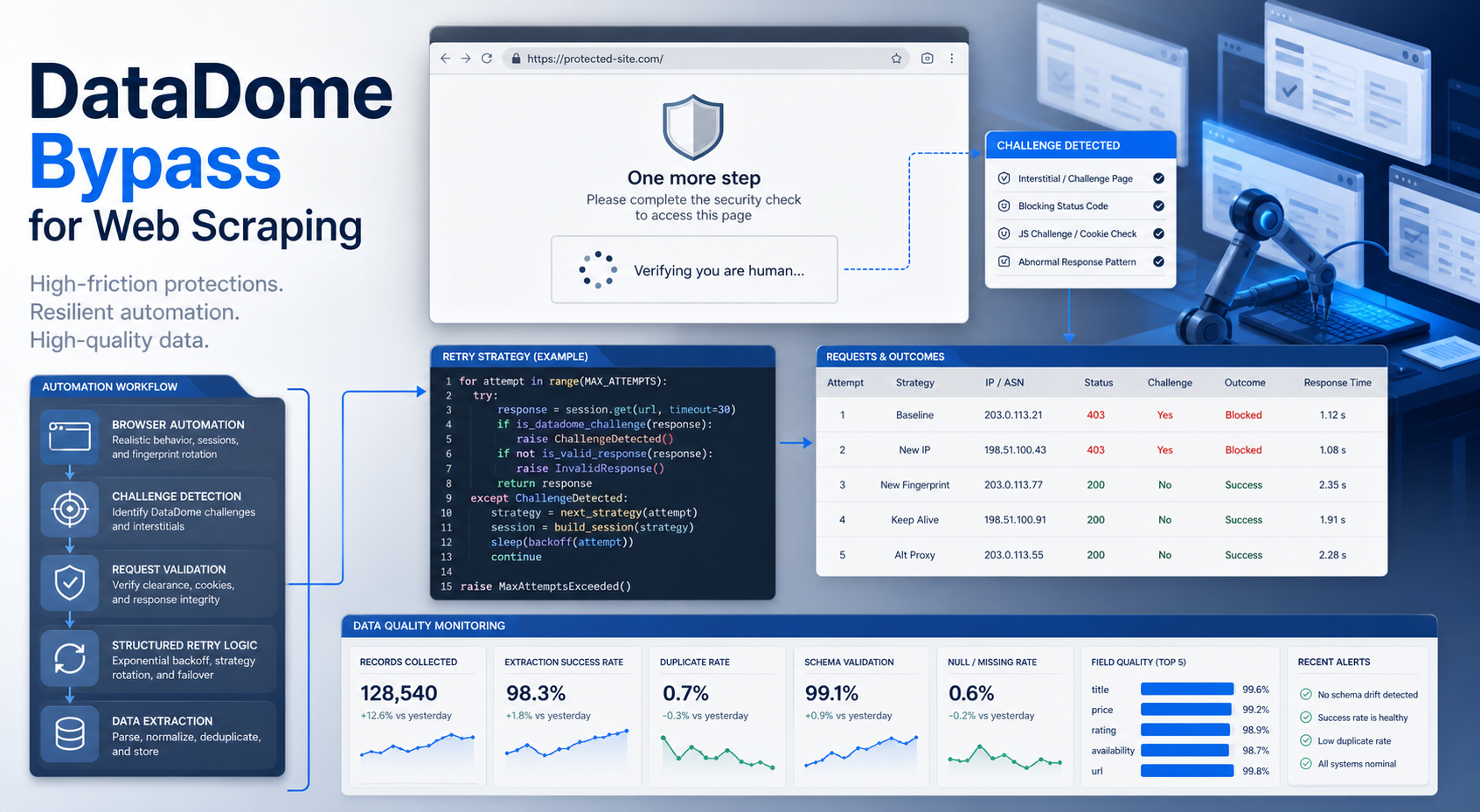
DataDome Bypass for Web Scraping
DataDome Bypass for Web Scraping
View Details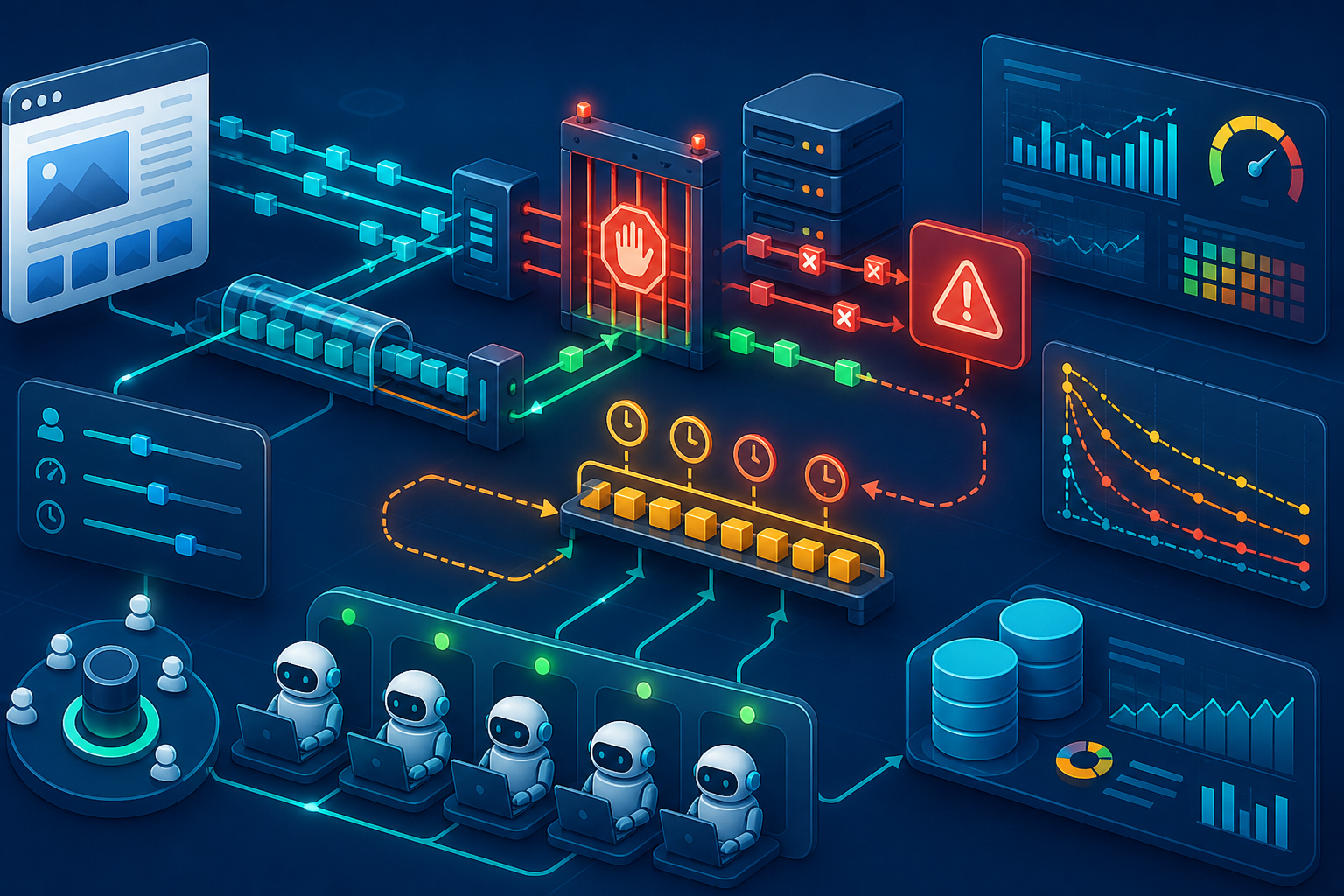
Web Scraping Rate Limiting: How to Handle 429s, Backoff, and Concurrency
Web scraping rate limiting is the engineering discipline of keeping an authorized collection workload inside a target service's acceptable request envelope. When that envelope is exceeded, a server may respond with HTTP 429 Too Many Requests, delay responses, or apply other controls.
View Details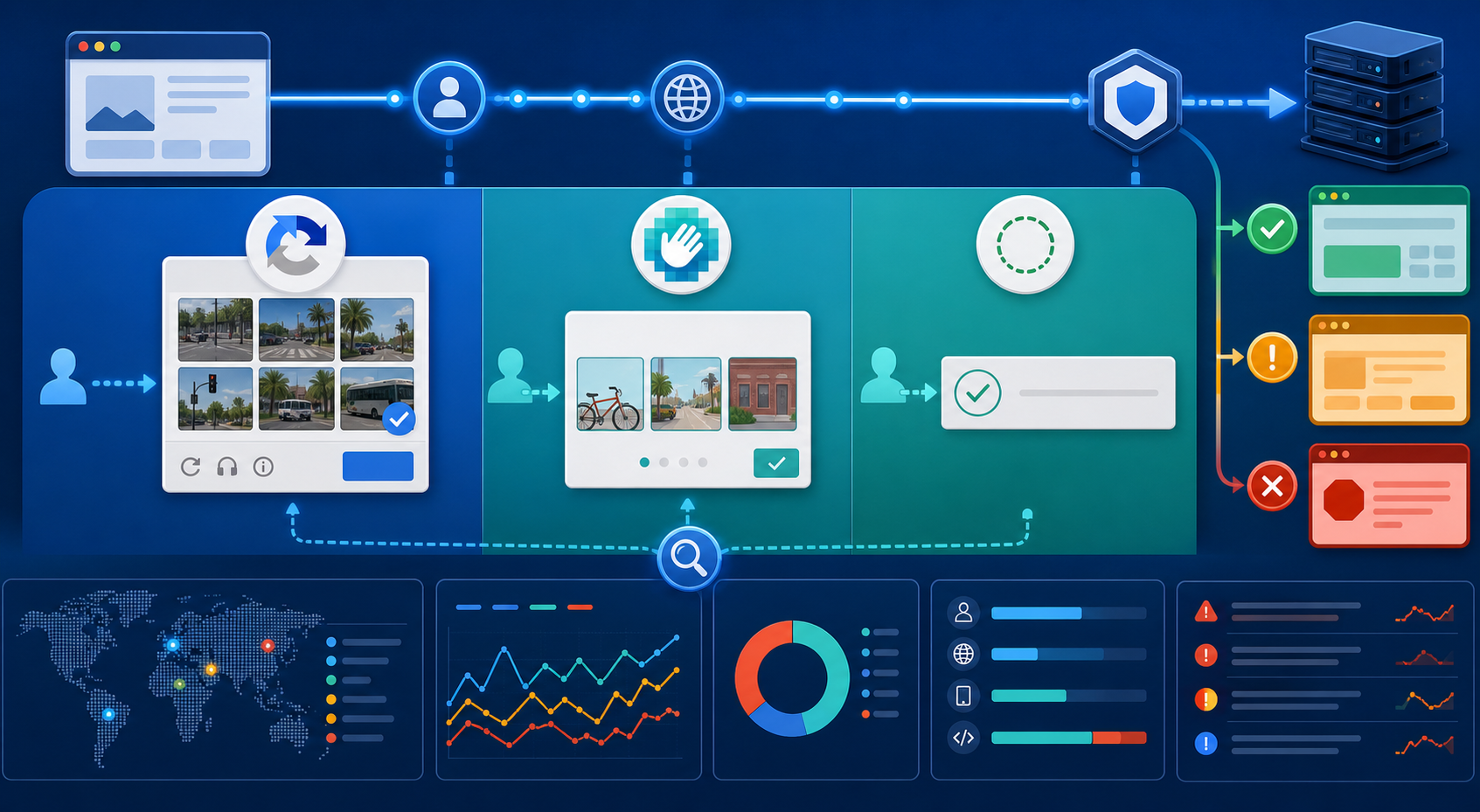
reCAPTCHA vs hCaptcha vs Cloudflare Turnstile: What Scraping Teams Need to Know
If an authorized data-collection workflow suddenly stops at a verification screen, identifying the protection system matters before you change code, browser settings, or proxy infrastructure. reCAPTCHA vs hCaptcha vs Turnstile is not simply a branding comparison. The three systems can expose different browser flows, token models, risk decisions, and failure symptoms.
View Details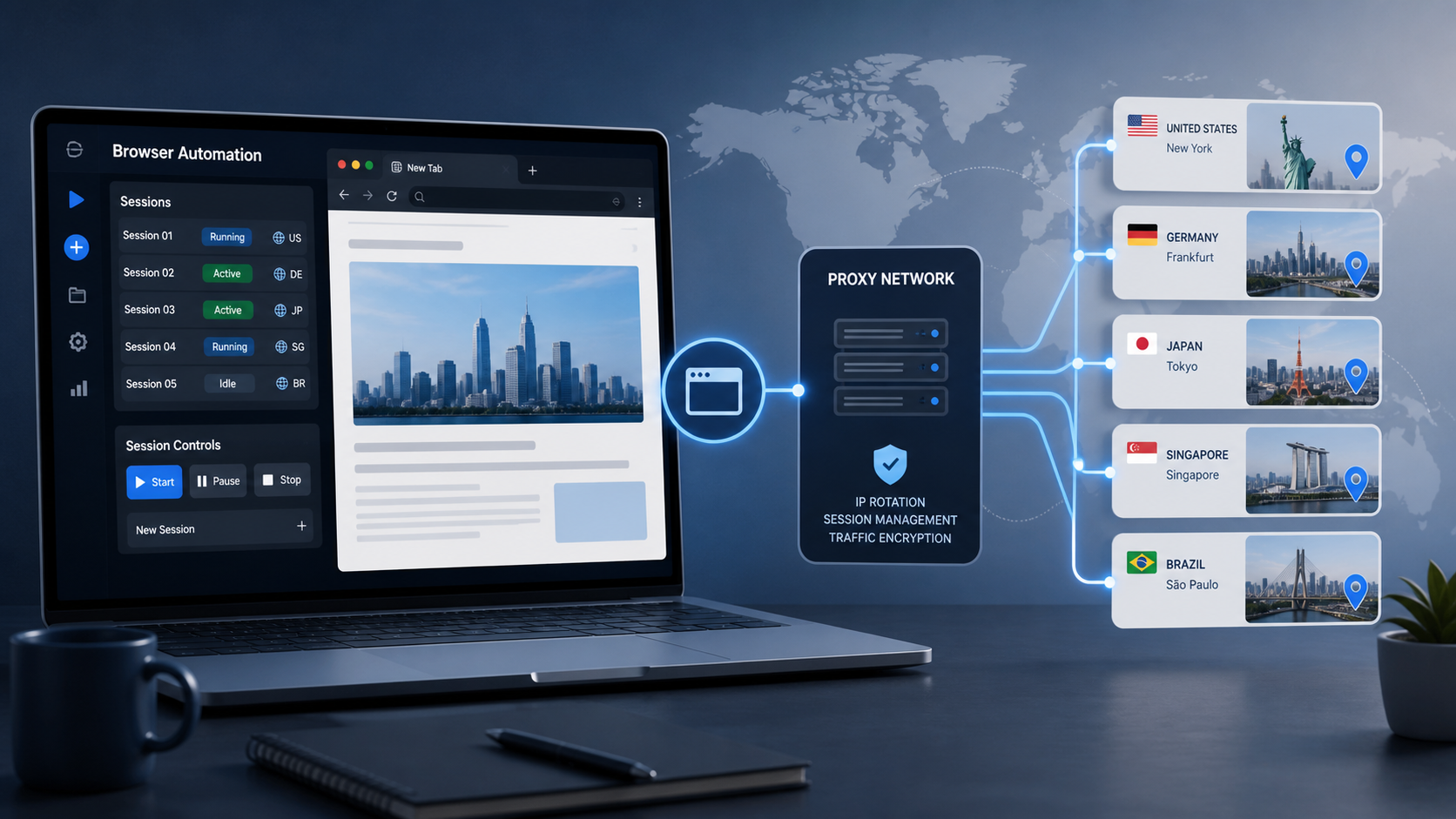
Browser Automation Proxies: IPs, Geo-Targeting, Sessions, and AI Agents
A browser automation proxy belongs to the network layer of Playwright, Selenium, cloud-browser, and AI-agent workflows. It changes how browser traffic is routed and can affect the source IP address, geographic egress, and session continuity seen by a destination site. It does not improve an AI model's reasoning, repair browser logic, or guarantee that a website will accept the session.
View Details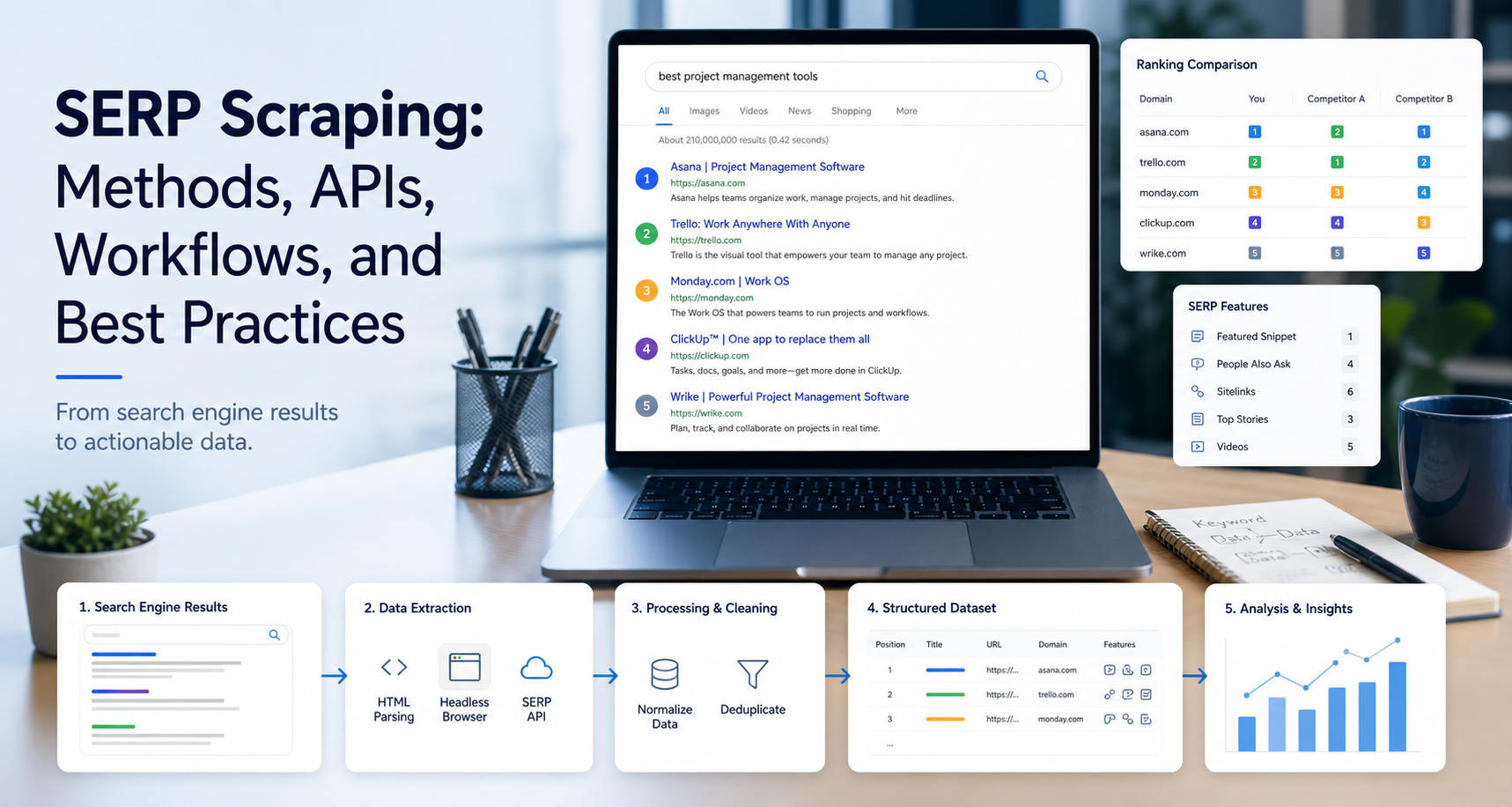
SERP Scraping: Methods, APIs, Workflows, and Best Practices
SERP scraping is the automated collection of information from search engine results pages. A SERP scraper can capture organic rankings, advertisements, featured snippets, People Also Ask questions, local results, shopping listings, images, and other search features, then convert them into structured data for analysis.
View Details